HR is one of the most writing-intensive functions in any organisation. Job descriptions, interview questions, performance reviews, policy documents, employee communications, onboarding materials, compliance records. The volume of text that moves through an HR team in a single month is substantial, and most of it follows recognisable patterns: similar structures, similar tones, similar information presented in slightly different configurations for different roles, teams, or situations.
That pattern-heavy, high-volume nature is exactly where AI performs well.
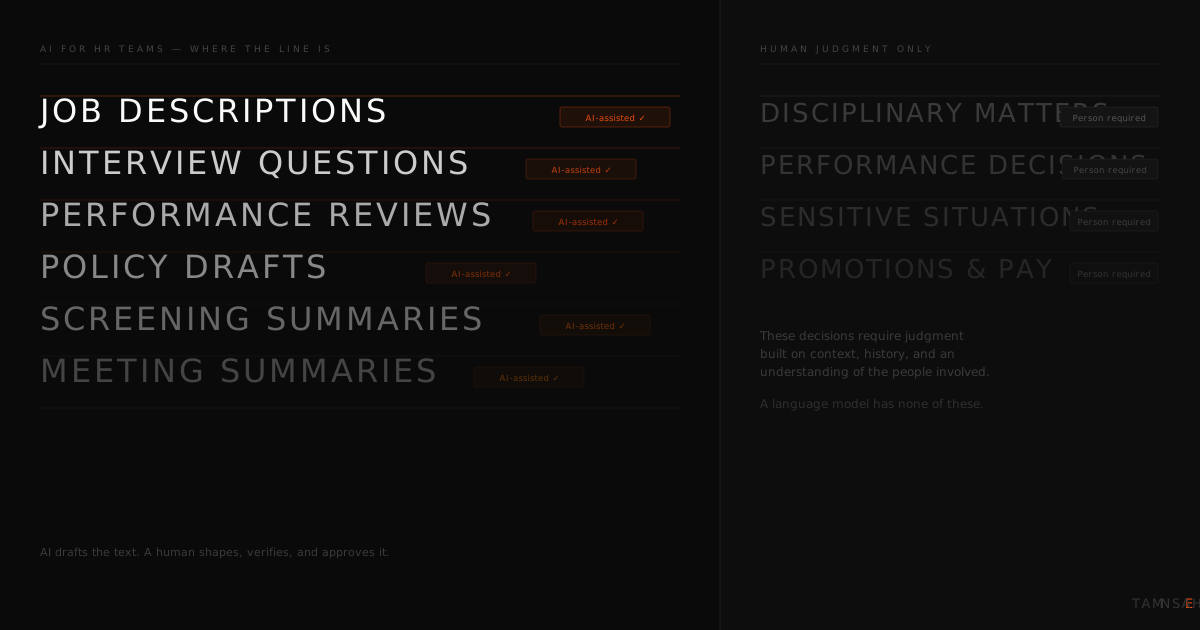
This is not an argument that AI should run your HR function. People decisions, sensitive conversations, disciplinary processes, and anything involving the kind of judgment that comes from knowing your organisation and the individuals in it are not tasks that belong to a language model. But a significant portion of the time HR teams spend every week is not on those decisions. It is on producing the documents that support and surround them. That is where the time savings are, and they are meaningful.
The honest picture first
Before covering what AI does well for HR teams, it is worth being direct about what it does not do.
AI does not know your organisation. It does not know the culture, the unwritten norms, the history behind a policy, or the specific dynamics of a situation. Every output it produces is a starting point shaped by your instructions, not a finished product shaped by context it has absorbed over time. The HR professional's role in the AI-assisted workflow is not to check that the output is grammatically correct. It is to ensure that the output reflects the organisation accurately and is appropriate for the specific people involved.
The distinction between AI-generated and AI-assisted is the useful one here. AI-generated content is produced by a model and published or shared without meaningful human review. AI-assisted content is produced by a model and reviewed, shaped, and approved by a professional who adds the judgment layer that a model cannot provide. The second approach is the only one that belongs in HR.
With that framing in place, here is where the time savings are real.
The HR tasks where AI saves the most time
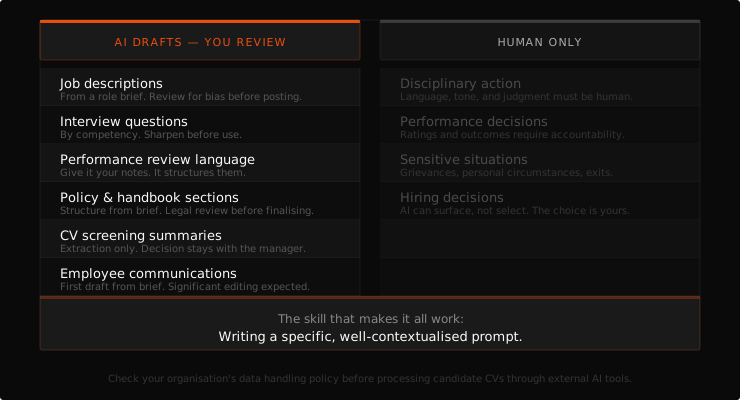
Writing job descriptions from a role brief
A job description typically takes between forty-five minutes and two hours to write from scratch, depending on the role and the writer. The structure is almost always the same: a role overview, a list of key responsibilities, a list of required qualifications, and a section about what the organisation offers. The variables are the role-specific details.
AI handles this structure well when given a clear brief. A prompt that includes the role title, the reporting line, the key responsibilities in rough note form, the required qualifications, and any specific tone or language notes will produce a first draft in under a minute that is structured, complete, and ready to review. The editing time is typically ten to fifteen minutes rather than an hour.
The place where human review is essential: bias. AI models, depending on how they are prompted, can reproduce gendered language, unnecessarily narrow qualification requirements, or phrasing that disadvantages certain groups. A direct instruction to "use gender-neutral language throughout and avoid unnecessary credential requirements" helps, but does not substitute for a review against your organisation's equity commitments.
Drafting structured interview questions by competency
Building a question bank for a specific role, organised by competency, is a task that most hiring managers put off until the last minute and then do quickly. The result is often a mix of generic questions and personal favourites that does not systematically assess the competencies the role actually requires.
AI produces structured question sets well when given a competency list and told the seniority level of the role. A prompt specifying five competencies, three behavioural questions per competency, and the seniority context produces a solid question bank in seconds. The questions will not always be perfect, some will be too generic, some will need sharpening, but the effort to edit is far lower than the effort to generate from a blank page.
Writing performance review language from notes
Performance reviews are one of the most universally dreaded writing tasks in corporate life, not because the underlying assessment is unclear, but because translating a clear assessment into language that is specific, fair, balanced, and professionally appropriate is harder than it looks. Blank page paralysis is common. Vague language is a common shortcut.
AI helps here in a specific way: give it rough notes about a person's performance in a review period, the key achievements, the areas for development, the overall assessment, and it produces structured, professional review language that can be edited rather than written from scratch. The key instruction is to give it the actual details rather than asking it to generate the assessment itself. "This person led the onboarding programme rollout for twelve new staff, reduced onboarding time by two weeks, but struggled with documentation consistency in Q3" produces something useful. "Write a performance review for an average HR officer" produces something generic.
Policy and handbook sections
HR teams are frequently asked to draft or update policy documents on short notice: a remote work policy following an organisational change, an AI use policy following the adoption of new tools, an amendment to the leave policy following a regulatory update. These documents follow recognisable structures and require clear, unambiguous language.
AI drafts policy sections well from a brief that covers the scope of the policy, the key rules or entitlements, any compliance requirements, and the intended audience. The output needs legal and compliance review before it is finalised, but the drafting stage, which is usually the most time-consuming for HR teams without a dedicated policy writer, is significantly faster.
Candidate screening summaries from CVs
Shortlisting a stack of CVs involves reading each one, extracting the relevant information, comparing it against the role requirements, and making a judgment. The judgment step is human and should stay human. The extraction step is not.
Pasting a CV into ChatGPT or Claude with a prompt that specifies the role requirements and asks for a structured summary of how the candidate matches or does not match those requirements produces a consistent, comparative summary for each CV in the stack. The time saving on a shortlisting exercise with fifteen or twenty applicants is significant. The hiring decision should still be made by a person reviewing the full CVs, but the initial comparison is faster and more systematic.
One important note on data privacy: CVs contain personal information. Before using AI tools to process candidate data, confirm that your organisation's data handling policy permits sending personal information to external AI platforms. Some organisations use local or enterprise AI tools for this reason specifically.
Employee communications
Sensitive employee communications, announcements about organisational changes, messages about difficult decisions, or communications that require a careful balance of clarity and empathy, are exactly the kind of writing where the blank page is most paralyzing.
AI can produce a first draft of these communications from a brief that covers the key message, the audience, the tone required, and any information that should not be included. The first draft will almost always need significant editing, and the final version must be reviewed carefully by someone who knows the organisational context. But having a first draft to react to is usually faster than writing from nothing, and it separates the structural question (what should this communication cover and in what order) from the editorial question (is this the right language for these people in this situation).
Meeting summaries and action logs
HR teams are often the administrators of significant meetings: job evaluation panels, disciplinary hearings, policy review sessions, onboarding briefings. The documentation of those meetings, capturing decisions and next steps accurately, is a compliance matter in many cases and a practical necessity in all of them.
Uploading a meeting transcript or pasting rough notes into an AI tool with a clear prompt produces a structured summary with action items, owners, and deadlines extracted in a fraction of the time it takes to write from scratch. For teams using tools like Otter.ai or Fireflies.ai, the transcript is generated automatically and can be passed directly to a language model for summarisation.
Where AI needs more supervision in HR
Anything involving an individual employee's sensitive situation, a disciplinary matter, a grievance, a performance improvement plan, or a termination, requires human drafting or very careful human review before any AI-assisted content goes anywhere near the affected person. The risk is not just legal. It is the risk of language that feels impersonal, inaccurate, or tone-deaf in a situation where those qualities cause real damage.
Compliance-heavy documentation, particularly anything that relates to employment law, data protection, or sector-specific regulations, must be reviewed against the relevant legal requirements before it is relied upon. AI models do not have current legal knowledge and will produce plausible-sounding content that may not reflect the actual regulatory position.
And finally, AI should not be making performance assessments, hiring decisions, or promotion recommendations. It can support the documentation of those decisions. The decisions themselves belong to people who are accountable for them and who understand the full context.
How to start with AI in an HR team
The most common mistake HR teams make when adopting AI is trying to introduce it across the function simultaneously. Multiple tools, multiple use cases, a policy before there is any practice. The result is low adoption and no clear sense of what is actually working.
A more effective approach is to identify the single most time-consuming writing task in the team's current workflow and focus AI adoption there first. For most HR teams, that task is either job descriptions or performance review language. Pick one. Spend two weeks using AI consistently on that task. Build a prompt that works for your organisation's style and context. Then decide what to add next.
The prompt is the skill, not the tool. An HR professional who knows how to give a specific, well-contextualised brief to an AI model will get useful output from a free ChatGPT account. One who does not will get mediocre output from any tool regardless of the subscription tier. Time invested in learning to prompt well transfers across every tool the profession will encounter over the next decade.
What a tailored HR training session covers
A TAMENSAH AI workshop for HR teams is built around the tasks described in this article, not a generic introduction to AI tools. Participants work on job descriptions, review language, and communications from their actual workloads during the session. They leave with prompt structures that work for their specific organisation's roles, a clear sense of where AI belongs in their workflow and where it does not, and the confidence to keep experimenting after the session ends.
The session is available as a standalone three-hour workshop for a full HR team, or as a one-hour department deep-dive for a smaller group that already has some AI exposure and wants to go further.
Ready to move from reading about AI to your team actually using it?
See Training Formats & Pricing