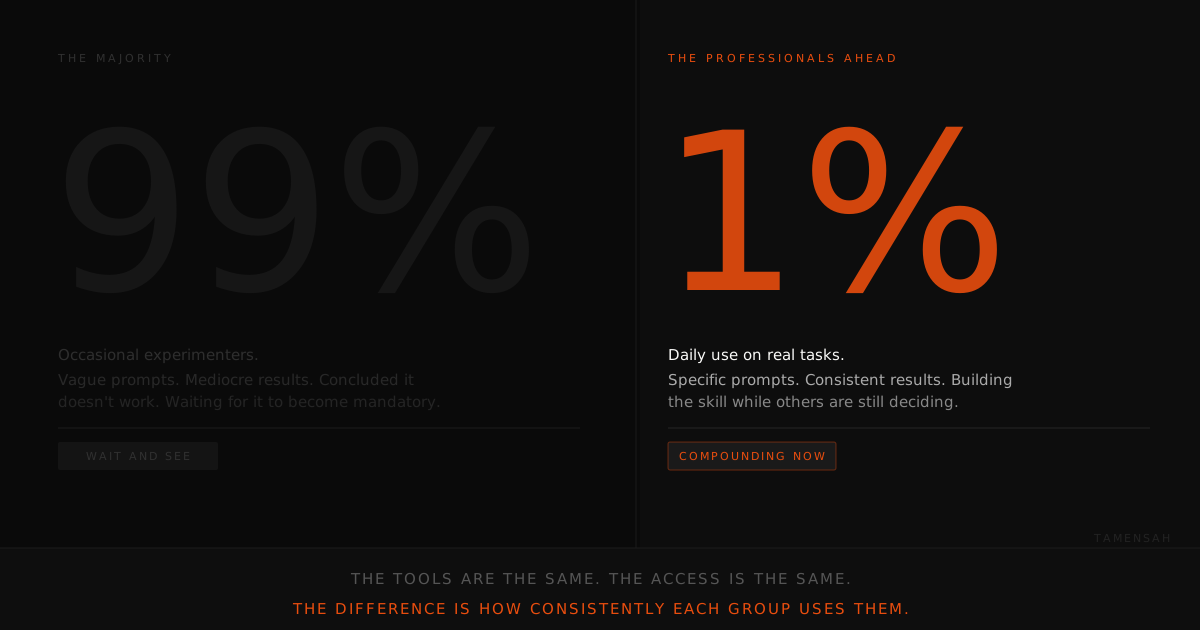
The gap between professionals who use AI well and those who do not is forming right now, and it is not primarily about access. Most working professionals across Africa and beyond have the same tools available to them: ChatGPT, Claude, Gemini, all free or near-free, accessible on any device with an internet connection. The tools are not the differentiator. What is forming the gap is who builds genuine daily competence with those tools and who waits.
The waiting strategy has a cost that is invisible in the short term and compounding over time. The professional who is three months ahead of their peers today will not be three months ahead in a year. They will be substantially further ahead, because skill accumulates while hesitation does not.
What getting ahead actually means
This is not an argument that AI will take anyone's job. It is an observation about the professional who can produce more, faster, at a higher quality standard, than the colleague sitting next to them with the same tools and the same working hours. The finance professional who produces a polished board report in forty-five minutes while the next person spends most of a day on it. The communications manager who delivers a complete stakeholder update, a media response brief, and a social content calendar in a morning that would normally fill a week. The HR practitioner who turns around a full structured interview framework within twenty minutes of receiving a new role brief.
That kind of output advantage is real and observable. It comes from two things, both learnable. And in a professional environment where most people are still deciding whether to start, being a consistent practitioner is more than enough to stand out.
Why most professionals are not there yet
The majority of working professionals are in one of two positions. The first is "wait and see": they are aware that AI tools exist and are waiting for their organisation to make it official before investing time in learning. The second is "tried it once": they used an AI tool, gave it a vague instruction, received a generic output, concluded that it was not quite useful for their kind of work, and moved on.
The second group is particularly important to understand, because the conclusion they drew was wrong. Generic output from an AI tool is almost always a symptom of a vague instruction, not a ceiling on what the tool can do. The tool gave them what they asked for. They just did not ask for very much.
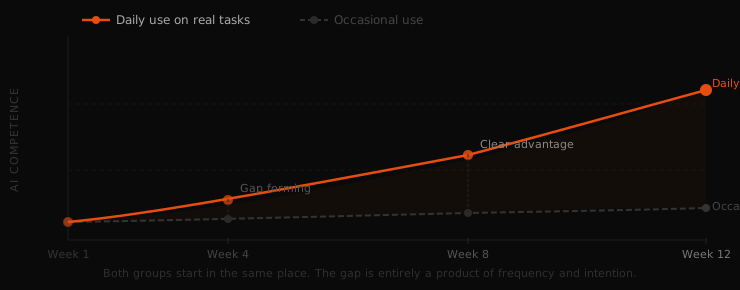
That misdiagnosis creates the gap. The professional who understands why generic output happens and corrects for it is on the orange curve. Everyone else is on the grey one. Both curves start at the same point, but they diverge quickly and do not converge again.
The two things that actually separate those professionals
Consistent daily use on real tasks
The first factor is frequency applied to the right kind of work. Not experimenting with AI once a week when something interesting comes up. Using it every day, consistently, for the specific tasks in your role that are high-volume, pattern-heavy, and writing-intensive: drafting, summarising, structuring, reformatting, producing first versions of documents that follow a recognisable format.
Daily repetition is what builds the pattern recognition that makes AI use fast and intuitive rather than effortful and unpredictable. After two weeks of daily use on the same task, you have a prompt that reliably works. After a month, you have refined it several times and can produce output that needs minimal editing. After three months, you have applied that learning across several task types and have developed an instinct for what AI will handle well and what it will not. None of that happens from occasional experimentation.
The ability to write a specific instruction
The second factor is what separates professionals who get consistently useful AI output from those who keep getting mediocre results regardless of how often they try. The quality of what any AI tool produces is determined almost entirely by the quality of the instruction it receives. A vague instruction produces a generic output. A specific, contextualised instruction produces something immediately useful.
The structure that works is consistent across any tool and any task: context first (who you are, what you are working on, who the audience is), then the task precisely described, then the format and constraints. "Summarise this report" produces a flat, undifferentiated paragraph. "Summarise this report in 150 words for the CEO, who has five minutes to read it. Lead with the single most important finding, then list the three decisions that need to be made before end of month. Use plain language with no jargon." produces something a person could use immediately.
That instruction structure is a learnable skill. Once it is internalised, it applies to every task on every tool, and it transfers directly from one platform to the next regardless of how the software changes.
How the advantage compounds
Both groups start from the same place. A professional who begins using AI consistently and one who uses it occasionally are at roughly the same level in week one. Neither has built much skill yet. The divergence is not dramatic at the four-week mark either. It is noticeable, but not transformational. The real divergence happens between months two and three.
The daily user at the three-month point has refined their prompt structures through repetition. They know which of their regular tasks AI handles reliably and which require more guidance. They have developed an intuition for framing a task so that the first output is close enough to edit rather than rewrite. They can estimate how long AI-assisted work will take because they have done it hundreds of times in context.
The occasional user at the three-month point is still in the experimental phase. Each session still feels like a fresh attempt. The ceiling that they perceived in week two is still the ceiling they perceive in month three, because they have not accumulated enough repetitions to see past it.
The advantage does not just persist. It compounds, because skill that is built through consistent practice keeps producing marginal improvements. The professional who is three months ahead at month three is not three months ahead at month six. They are further ahead, because their daily practice is still accruing while the other person's occasional sessions are not.
The disciplines where the gap is widest right now
Every professional role that involves high volumes of structured writing is a context where consistent AI use produces a visible advantage quickly. Finance professionals who produce regular reporting narratives, variance analyses, and board summaries. HR practitioners who draft job descriptions, interview frameworks, performance review language, and policy documents. Communications and public affairs teams who manage stakeholder updates, briefing notes, media responses, and internal announcements. Operations and project management professionals who maintain status reports, meeting summaries, risk logs, and handover documents.
The common thread is not the sector. It is the nature of the work: pattern-heavy, writing-intensive, repetitive in structure even when the content changes each time. That kind of work exists in every professional context. The professionals who identify it clearly in their own roles and focus their AI use there are the ones who see the compounding effect fastest.
What to do this week
Identify one task in your current role that you do repeatedly, that follows a recognisable structure, and that takes meaningful time to produce each time. Not the most complex or strategically important thing you do. The most repetitive structured writing task you do regularly.
For the next two weeks, use AI on that task every time it comes up. Write a prompt that gives the AI your context, the specific output required, the format it should take, and any constraints. Note what the output does and does not get right each time. Refine the prompt accordingly. By the end of two weeks, you will have a prompt that produces useful output reliably, a task that takes less time, and enough pattern recognition to identify the next candidate.
That is how the gap opens. Not dramatically, and not immediately. Gradually, through repetition and refinement, in a field where most professionals are still deciding whether to start. Gradual and consistent, applied while others are waiting, is more than enough.
For professionals who want to build this faster
Trial and error over two to three months is one path. A focused one-on-one coaching session is another. TAMENSAH one-on-one AI coaching sessions are structured around your specific role: identifying the right tasks to start with, building a prompt structure that works for your context, and practising on real work from your current responsibilities until the approach is solid. Sessions are available at US$60 per hour, and most professionals leave a two-hour session with prompt structures they can put to use immediately.
The gap is forming now. The professionals who are ahead at the end of this year will be the ones who started building the habit this month, not the ones who waited for a formal training programme to make it compulsory.
Ready to build your AI competence in a structured way, on your actual work?
See 1-on-1 Coaching & Team Training