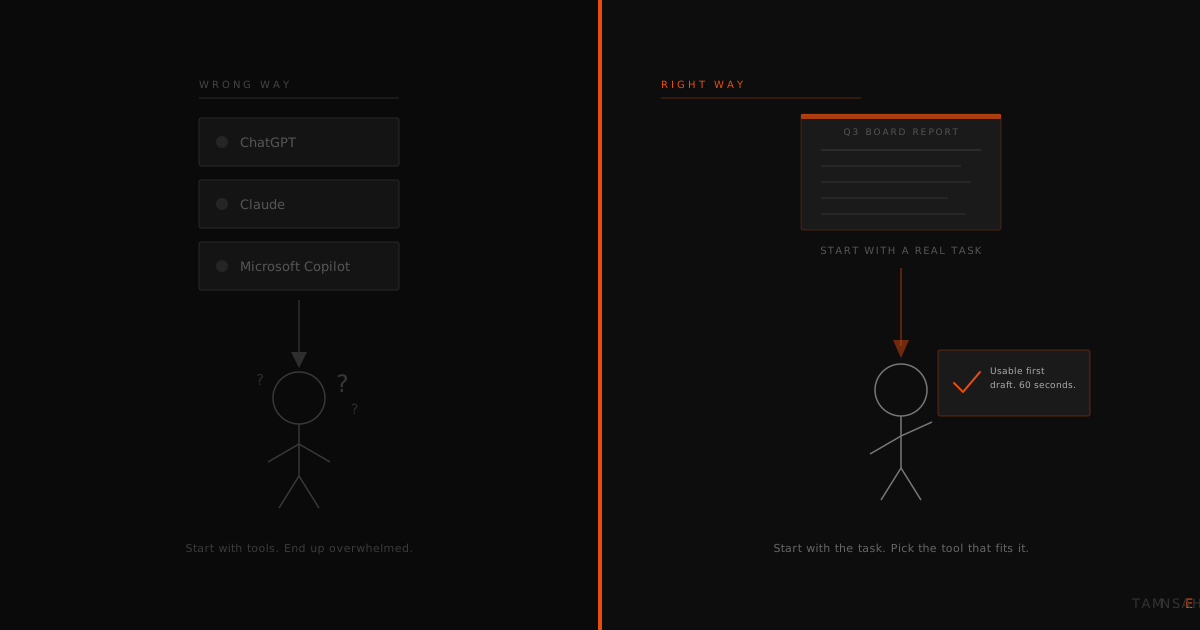
There is a particular moment that happens in almost every corporate AI training session. It usually comes in the first twenty minutes. Someone who arrived looking skeptical, arms folded, clearly wondering why they were pulled out of their actual work to sit through another technology demonstration, does something unexpected. They try a prompt on a task they have been doing manually for years, and it works. Not impressively, not magically, but well enough that they look up and say, "Wait. That actually just did it."
That moment does not happen by accident. And it does not happen when you send your team a list of AI tools and tell them to start using them.
Most AI rollouts fail long before anyone opens a tool. They fail in the way the conversation gets framed.
Why most AI rollouts fail before they start
The gap between "we should be using AI" and "our people are actually using AI" is wider than most leaders expect. Companies subscribe to tools, send announcement emails, maybe run one demonstration session, and then watch adoption stall. The tools sit unused or get used by the two or three people who were already curious about AI before the rollout began.
The reason is usually the same. The rollout was designed around the technology, not around the people using it.
There is a meaningful difference between showing your team what AI can do and helping them figure out where it fits in the specific work they do every day. Most AI demonstrations start with impressive features. Practical adoption starts with problems your team actually has.
When someone sees AI generate a polished business report, they might be impressed. When they see it draft the specific type of client update they spend two hours writing every Friday afternoon, something shifts. The question changes from "what can this do?" to "what can this do for me?"
That second question is where adoption begins.
Start with the resistance, not the roadmap
Before any training plan, before any tool selection, there is a conversation worth having with your team. Most leaders skip it.
The resistance to AI in the workplace is not usually about technology. It is about job security, about feeling behind, about the embarrassment of not knowing how to use something everyone seems to assume is simple. People who have spent years developing expertise in their roles are now being told that a tool can do parts of that job in seconds. That is disorienting, even for people who intellectually understand what AI is and is not.
The teams that adopt AI most quickly are the ones where that anxiety gets named early. Not dismissed, not over-explained, just acknowledged. Something as direct as: "We are not bringing this in to replace anyone. We are bringing it in because there is a significant amount of writing, formatting, and repetitive work in this organisation that nobody actually needs a person to do, and that time could be spent better."
That framing removes the need for people to defend themselves against the tool. Once resistance comes down, curiosity tends to follow.
The four-stage introduction that works
The following sequence is not a formal methodology with a trademarked name. It is what actually works, drawn from running workshops with corporate teams across a range of industries and technical backgrounds.
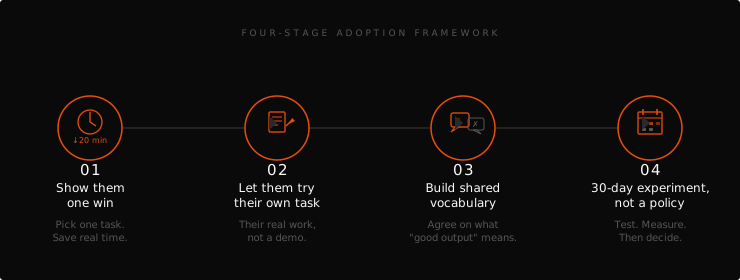
Stage 1: Show them one thing that saves them twenty minutes today.
Start with the most universally painful task in your team's workflow. For most office-based teams, that is some form of writing: emails, reports, meeting summaries, proposals. Pick one. Run a live demonstration where someone on the team gives their actual draft notes or a real brief, and show the output in real time.
The specificity matters. A generic demonstration of what ChatGPT can do produces mild interest. Watching it produce something that looks like the document you were going to spend an hour writing produces something different.
Stage 2: Let them try it on something they already hate doing.
The fastest path from watching to doing is through tasks people genuinely dislike. Ask your team: what is the most tedious thing you do regularly? Formatting reports, summarising long email threads, writing the same type of response over and over, drafting job adverts, producing meeting minutes. These are the entry points.
Give people time to try it with their own tasks, not pre-prepared examples. The results will vary. Some will work immediately, some will need a better prompt, some will not work the way they expected. That variation is valuable, because it teaches people that the quality of the output depends on the quality of the instruction. That is the most important lesson in practical AI use.
Stage 3: Build a shared vocabulary around what AI can and cannot do.
A team that has been using AI for two weeks will have encountered its limitations. It hallucinates facts. It misses nuance in sensitive situations. It can produce confident-sounding nonsense if not checked. It works best on tasks with a clear structure and a clear output format.
Rather than letting people discover this through bad experiences alone, name it directly. AI is a capable first-draft generator and a powerful research and summarisation tool. It is not a decision-maker, not a compliance officer, not a substitute for domain expertise or human judgment. Establishing that boundary early builds trust in the tool and prevents the overcorrection that happens when a team has one bad experience and concludes the technology is useless.
Stage 4: Set a simple thirty-day experiment, not a policy.
The worst thing an organisation can do after an AI introduction is immediately write a policy around it. Policies before habits produce compliance theatre. People do the minimum required and nothing more.
Instead, set a lightweight experiment. Three tasks per person. Try AI on each one for thirty days. Keep a note of what worked and what did not. At the end of the month, share what you found. That kind of low-stakes experimentation produces genuine learning, and it surfaces the use cases that actually matter to your specific team rather than the ones that look good in a generic training programme.
What "AI-ready" actually looks like in practice
There is a tendency in organisations to treat AI readiness as a destination, something you achieve after sufficient training and tool adoption. That framing creates unnecessary pressure and an unrealistic standard.
An AI-ready team is not a team where everyone has mastered every tool. It is a team where people have enough confidence to try, enough understanding to evaluate the output, and enough permission from their environment to experiment without fear of getting it wrong.
The goal is not to turn your operations manager into a prompt engineer. The goal is to get to a point where she can use AI to prepare the monthly board summary in half the time it currently takes, because she knows how to ask for what she needs and how to check what she gets.
That is achievable in a single well-run session, for most teams. The barrier is rarely the technology. It is the first confident attempt.
When to bring in outside training and when to DIY
For small teams with one or two people who are already using AI regularly, internal knowledge sharing is often enough. A dedicated hour where those people walk the rest of the team through the tasks they have found most useful, followed by some time to try it themselves, can produce real results.
For larger teams, teams with mixed technical confidence, or organisations where AI adoption is a strategic priority rather than a side project, bringing in structured training significantly shortens the timeline. The difference is not just the content covered. It is the experience of a trained room where questions get answered in real time, where the demonstration is tailored to your industry and your workflows, and where people leave with a working set of prompts for the tasks that matter to them specifically.
A well-designed AI workshop does not feel like a technology briefing. It feels like a practical working session where people leave with fewer items on their to-do list than when they arrived.
If you are at the stage where you are ready to move the conversation from "we should be using AI" to "our team is actually using it," a structured session is usually the fastest route.
Ready to move from reading about AI to your team actually using it?
See Training Formats & Pricing