Every organisation experimenting with AI hits the same divergence. Some teams find that AI saves them meaningful time from the first week. Others try it, find the outputs mediocre or irrelevant, and quietly stop. A few weeks later, the tools are still installed but not used, and the general conclusion is that AI is not quite ready for their kind of work, or that their team needs more time to adapt.
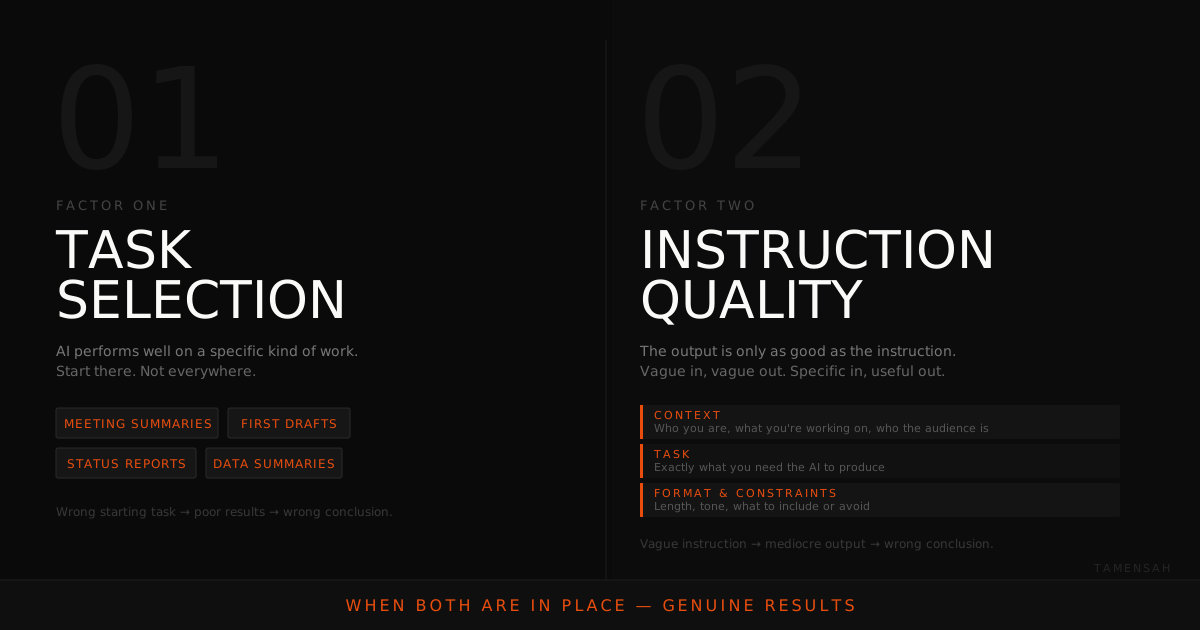
The difference between those two outcomes is almost never the tool. Both groups are usually using the same tools. It is not the team either. Staff in both groups are equally capable. The difference comes down to two things, and when both are in place, AI produces genuine results. When either is missing, it does not.
Factor one: task selection
AI performs well on a specific kind of work. Understanding what that kind of work looks like is the first factor that determines whether a team gets real value from it.
The tasks where AI consistently performs well have a few things in common. They are high-volume: the kind of work that comes up repeatedly, in similar configurations, throughout the week or month. They are pattern-heavy: they follow a recognisable structure, even if the specific content varies each time. And they are writing-intensive or text-heavy in their output: the final deliverable is a document, a summary, a draft, a report, an email, or a set of notes.
Meeting summaries are a good example. Every meeting summary has roughly the same structure: what was discussed, what was decided, what happens next and who is responsible. The content changes each time, but the structure is almost identical. AI handles that structure reliably. Give it a transcript or rough notes with a clear instruction, and it produces a well-organised summary in seconds. The time saving is real and consistent.
First drafts of standard communications are similar. Internal updates, external stakeholder reports, policy announcements, performance review language from notes, job descriptions from a brief: all of these follow patterns that AI can replicate when given adequate context. They are not simple tasks, but they are structured ones, and structure is what AI is good at.
The tasks that mislead teams
The tasks that lead teams to the wrong conclusion about AI are the ones that fall outside that pattern. Original strategic thinking requires judgment that draws on organisational history, stakeholder dynamics, and situational context that AI does not have access to. Creative direction, sensitive employee conversations, and decisions that depend on knowing the specific people involved are not tasks that belong in an AI workflow, at least not as primary outputs.
The problem is not that these tasks are impossible to put into AI. It is that the outputs tend to be generic, shallow, or simply wrong in ways that a person would catch but a machine cannot. If a team's first experience with AI is on a task in this category, the conclusion they draw is that AI is not useful, and that conclusion sticks even when the right tasks are sitting right next to it.
The question worth asking at the start of any AI adoption effort is specific: which tasks in this team's current workflow are high-volume, pattern-heavy, and writing-intensive? Those are the starting points. Everything else comes later, if at all.
Factor two: instruction quality
The second factor is the one that determines results even when the task selection is right. AI tools produce output that is directly proportional in quality to the instruction they receive. This is not a limitation that will be fixed in the next version of the software. It is fundamental to how these systems work.
A vague instruction produces a generic output. "Summarise this meeting" produces a bland, structureless paragraph. "Write a job description" produces a generic template that fits no particular role. "Help me respond to this email" produces something technically responsive but probably misaligned with the actual relationship, tone, and history involved.
A specific instruction produces a useful output. The difference is not in the AI's capabilities. It is entirely in what the AI was told.
What a specific instruction looks like
A useful prompt gives the AI three kinds of information: context, task, and constraints. Context is the situation: who is writing this, for whom, and what is the relevant background. Task is the specific output required, described precisely. Constraints are the parameters the output must work within: length, tone, what to include or avoid, what format it should take.
To use the meeting summary example: "Summarise the notes below into a clear meeting summary. The audience is the finance director, who was not present. Include decisions made, open questions that need resolution, and action items with owners and deadlines. No more than 300 words. Use plain, direct language." That instruction produces something a person could send. The vague version produces something a person would have to rewrite entirely, which takes almost as long as writing from scratch.
The gap between those two outputs is not a matter of AI capability. It is a matter of instruction quality, and instruction quality is a learnable skill. The structure, context, task, and constraints, applies to any kind of task, on any AI tool. A team that learns that structure has something that transfers across every platform they will ever use.
Why vague instructions lead to the wrong conclusion
Most people who try AI tools for the first time and find the results disappointing are not using the wrong tool. They are using vague instructions, getting mediocre output, and concluding that the technology is not there yet. The conclusion is wrong, but it is understandable: when you put in a reasonable effort and get an unreasonable result, the natural interpretation is that the system is at fault.
The issue is that the effort that feels reasonable to a person, "ask it what you need," is not the kind of effort that AI responds well to. What AI responds to is specific, contextualised instruction. Learning to provide that instruction consistently is the skill that separates teams that get real value from AI from teams that do not.
Why both factors have to be in place
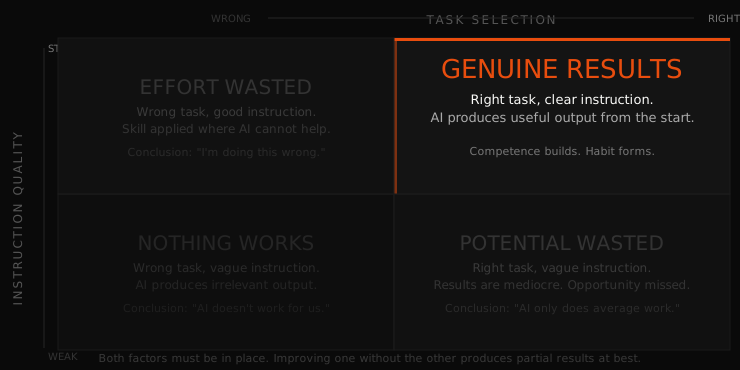
The four possible combinations are instructive. Wrong task and weak instruction: AI produces output that is both irrelevant and generic. The conclusion is that AI does not work, full stop. Wrong task and strong instruction: AI is given a clear and specific brief on a task it cannot do well. The output is better-structured but still misses, and the conclusion is usually that the person doing the prompting must be doing something wrong.
Right task and weak instruction: the most common situation in teams that have identified the right use cases but not invested in prompting skill. The potential is there, but the output is consistently just below the threshold of usefulness, requiring too much editing to justify the time saved. Right task and strong instruction: AI produces outputs that are immediately useful, require minimal editing, and save meaningful time. Confidence builds. The habit forms. Adoption follows naturally.
Neither factor is sufficient on its own. A team that picks the right tasks but writes vague instructions will get partial results and eventual scepticism. A team with strong prompting skills applied to the wrong tasks will invest effort where AI cannot deliver. Both need to be in place, and both are learnable.
Where to start
The practical starting point for any team is to identify one task, just one, that is high-volume, pattern-heavy, and writing-intensive. Then spend two weeks using AI consistently on that task with a prompt structure that specifies context, task, and constraints. Not a different task every day. Not ten tasks simultaneously. One task, consistently, until the prompt is refined and the time saving is visible.
From there, the second task is easier to identify because the team now has a working model of what AI-suitable work looks like. The prompting skill also transfers directly: the same structure that produces a useful meeting summary produces a useful first draft, a useful policy section, a useful status report. The skill generalises. The tool becomes a reliable part of the workflow rather than an experiment that keeps getting restarted.
How TAMENSAH training addresses both
A TAMENSAH corporate AI session is designed to work on both factors in sequence. Before the session, participants identify the specific tasks from their actual workload that fit the pattern: high-volume, structured, writing-intensive. During the session, they learn and practise a prompt structure that produces consistent, useful output on those tasks. They leave having applied both factors to their real work, not to a hypothetical exercise.
That combination, right task plus clear instruction, is where the results are. Everything else is secondary.
Want to identify the right AI tasks for your team and build the prompting skill to match?
See Training Formats & Pricing