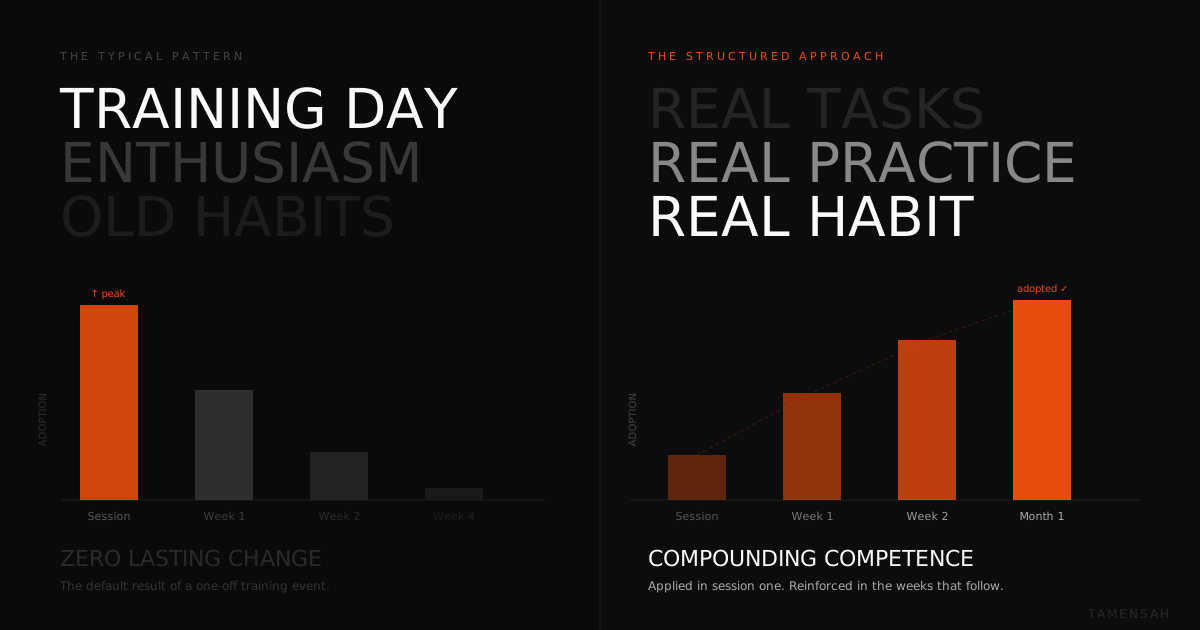
Most organisations that invest in AI training see the same arc. The session goes well. Participants engage, ask questions, and leave with some sense of what is possible. For a few days, sometimes a week or two, a few people experiment. A manager tries it on a report. Someone shares a result in the team chat. And then, gradually, the old workflows reassert themselves. The tools sit bookmarked but unopened. The enthusiasm fades. Within a month, very little has changed.
This is not an unusual outcome. It is, for many organisations, the default one. And when it happens, the tendency is to attribute it to the wrong things: the tool was not quite right for the team, the staff were resistant to change, the content was too basic or too advanced, the timing was off. These are sometimes contributing factors. But the deeper problem is structural, and it shows up consistently regardless of those variables.
Why it doesn't stick
Training as a one-time event
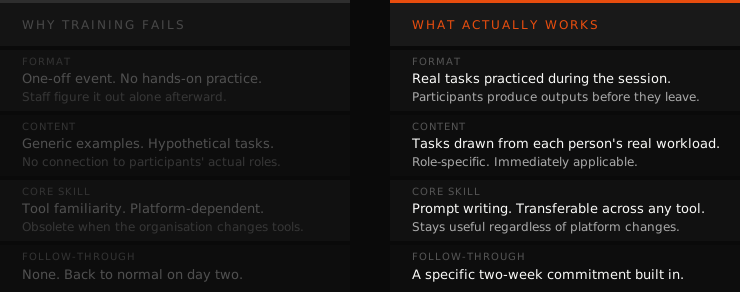
The most common AI training model is a single session of a few hours, covering a broad introduction to tools and concepts, delivered to a mixed group with different roles and different levels of comfort with new technology. It is designed to cover ground efficiently. And it does. But coverage is not the same as adoption.
Research on skill acquisition is consistent on this point: a single exposure to new information, without practice, without reinforcement, and without application to a real task under conditions that resemble actual work, produces minimal long-term retention. The session teaches people what AI can do in principle. It does not teach them how to use it in their specific job tomorrow. That gap between understanding a capability in theory and being able to apply it in context is where adoption breaks down.
Generic content with no connection to real work
A session that uses hypothetical examples, generic demonstration prompts, or fictional tasks creates a practical distance that most people cannot bridge on their own. Seeing that an AI tool can write a generic job description is not the same as knowing how to prompt it for your organisation's specific role structure, your industry's terminology, and your communication standards. The gap between the demonstration and the actual use case is where most people get stuck, and where they quietly stop trying.
The staff who do adopt AI after generic training are almost always the ones who were motivated enough to experiment independently regardless of the session content. For everyone else, generic training produces generic outcomes.
Tool familiarity instead of transferable skill
AI tools change. ChatGPT, Claude, Gemini, Copilot: the specific platform matters far less than the ability to communicate clearly with any of them. Training that focuses on navigating an interface rather than on writing effective instructions builds a competence that becomes obsolete the moment an organisation changes platforms, or a platform updates its interface significantly. The underlying skill, knowing how to write a specific, well-contextualised instruction that produces useful output, transfers across every tool and every version. That is the skill worth building.
No structure for what happens after the session
Even well-designed training produces minimal lasting change without a clear structure for the two weeks that follow. Who is accountable for applying what was covered? What does first use actually look like in practice? Who do staff ask when they hit a wall? Without clear answers to those questions, the path of least resistance is to continue as before. Not out of resistance to change, but because continuing as before requires nothing new of anyone.
What actually works
Real tasks, not demonstrations
The most effective AI training sessions are structured so that participants work on their actual tasks during the session itself, not watch someone else work on hypothetical ones. They bring the report they need to write this week, the policy document they are drafting, the analysis they have been putting off. The session is built around those tasks rather than generic examples. By the end, participants have outputs they can actually use, and they produced those outputs themselves.
This has a practical effect that no demonstration can replicate: people leave with direct evidence that the tool works for their specific context. That evidence is what overcomes scepticism. It is a different kind of confidence from understanding that AI could, in theory, help with this kind of task.
Role-specific, not function-wide
A finance team, a communications team, and an operations team all use AI differently. Training that tries to cover all those contexts in one session covers none of them well. Sessions focused on one function, one set of tasks, or one clearly defined use case consistently produce better adoption because the prompts, examples, and practice exercises are all directly relevant to the people in the room.
The useful question to ask before booking any AI training session is simple: at the end of this, what specific task will each person be able to do that they could not do confidently before? If the answer is vague ("understand AI tools" or "get comfortable with AI") rather than specific ("draft a structured board summary from rough notes in under fifteen minutes"), the session design probably needs sharpening.
Prompt writing as the core skill
The quality of what any AI tool produces is determined almost entirely by the quality of the instruction it receives. An employee who knows how to write a specific, well-contextualised prompt will get useful output from a free tool. One who does not will get mediocre output from any enterprise subscription. Training that builds prompt-writing competence produces something durable: a skill that transfers across tools, updates, and platforms.
The structure of a good prompt, covering context, task, format, and constraints, is learnable and directly applicable to any kind of professional work. Participants who leave a session with that structure, and who have already used it on their own tasks, can apply it the next day without further instruction.
A commitment built into the format
What happens in the two weeks after a session matters more than most organisations acknowledge. The first time a participant applies AI independently, in a real work context without support, is where adoption either takes hold or quietly fails. Training that includes a specific follow-through structure, one task, one prompt pattern, applied consistently for ten working days, significantly increases the chance that the new behaviour becomes a habit rather than a memory.
"Use AI for all first drafts of external communications for the next two weeks" is a commitment that works. "Try to use AI more in your work" is not. Specificity is what makes it actionable.
How to assess whether a training offer will actually work
Before committing to an AI training session, a few direct questions cut through quickly. What tasks will participants practice during the session, and are those tasks drawn from participants' actual work or from generic examples? How does the training account for different roles, responsibilities, or levels of AI experience within the group? What prompt structures will participants leave with, and are those structures transferable across different AI tools? What follow-through does the session include for the weeks after it ends?
A training offer that cannot answer those questions clearly is probably designed around delivery rather than outcomes.
How TAMENSAH sessions are structured
Every TAMENSAH corporate AI session starts with what participants actually need to produce. Before each session, a short brief goes to participants asking for the two or three tasks that take the most time in their current week. The session is built around those tasks. Nobody practices on hypothetical examples. Everyone leaves with prompt structures they wrote, tested, and refined on their real work, not on a trainer's demonstration.
Sessions are available as a three-hour full-team workshop or as one-hour department deep-dives for teams that want focused, role-specific training rather than a broad introduction. For organisations that want to go further, a follow-up session two to three weeks later reviews what worked, addresses what did not, and sharpens the team's approach based on actual use in the intervening period.
Ready to run an AI training session that actually changes how your team works?
See Training Formats & Pricing