When a company books an AI training workshop for the first time, the expectation is usually some version of a lecture. A presenter at the front of the room. Slides about what AI is, what it can do, where it is heading. Q and A at the end. People leave knowing more than they did before, but not necessarily doing anything differently on Monday morning.
That is not how a well-run AI training session works.
The distinction matters because the goal is not awareness. Most people already have enough awareness. They know AI exists, they know their colleagues are using it, they have heard the headlines. What they do not have is a concrete, confident starting point for their own role. A training session that ends with more awareness but no practical muscle memory has not moved that needle.
What follows is a direct account of how TAMENSAH structures a corporate AI workshop, what participants actually do during the session, and what a team typically looks like on the other side of it.
What happens in the room
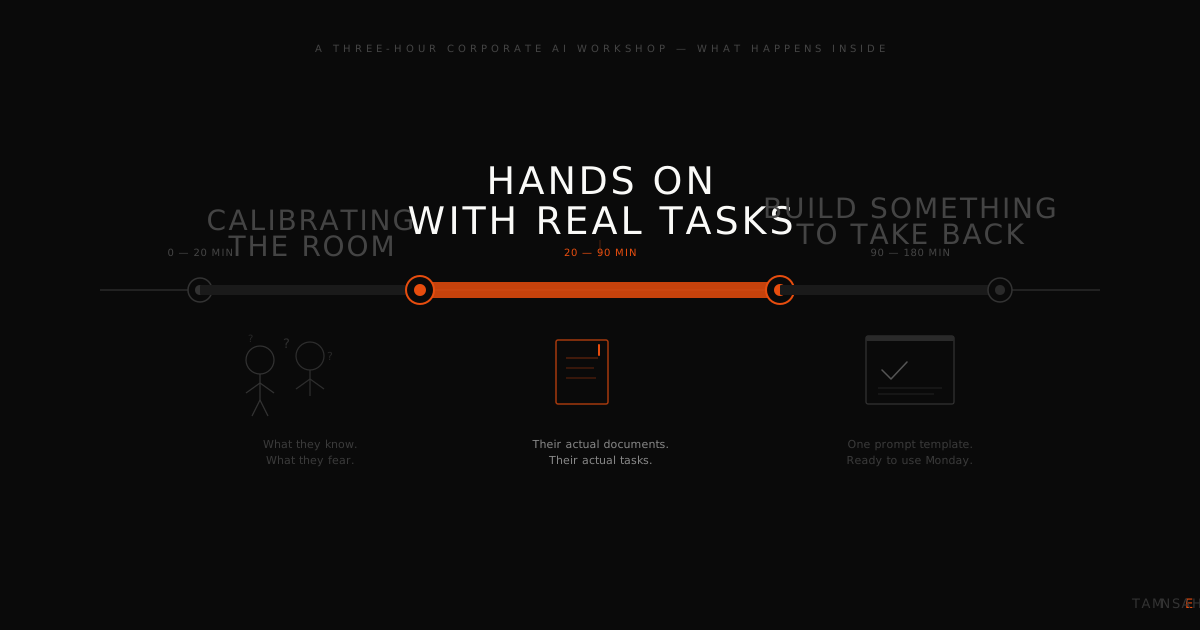
The first twenty minutes: calibrating the group
No two teams arrive at the same place. Some groups have one or two people already using AI daily and a majority who have never opened ChatGPT. Some groups are skeptical and need to see something genuinely useful before they will engage. Some arrive curious and competitive and want to start immediately.
The first part of the session is about establishing where the group actually is, not where the pre-session questionnaire suggested they might be. A few direct questions to the room, about what tools people have tried, what results they got, and what tasks they find most repetitive in their workday, produce more useful information than any survey. Those answers shape what the next ninety minutes covers.
This is also when resistance surfaces. Someone usually says something that represents what several others in the room are also thinking but have not said out loud: a concern about job security, a scepticism about whether any of this is real, a bad experience with an AI output that was confidently wrong. Those concerns get addressed directly, not dismissed, because people who feel unheard do not engage, and people who do not engage leave the session having learned very little.
The middle section: hands-on with real tasks
The core of the session is not a demonstration. It is a working period where participants use AI on tasks they actually have.
Before the session, participants are asked to come prepared with one or two things: a real work task they find time-consuming, a document they need to draft, a meeting they need to summarise, a report they are putting off. Those become the material for the session. Not example tasks. Not fictional scenarios. The actual work sitting in their inboxes.
The difference this makes is significant. When someone uses AI on a made-up task during a workshop, the result is interesting but abstract. When someone uses it on the exact report they have been avoiding writing for three days, and they get a workable first draft in forty seconds, the experience is concrete and personal. That is the kind of experience that changes how someone thinks about a tool.
During this period, participants write prompts, evaluate the output, iterate, and develop a sense of what works and what does not for their specific type of task. The facilitator moves through the room, looking at what people are working on, adjusting prompts in real time, and making the connection explicit between prompt quality and output quality. That connection is the most important lesson in the session, and it needs to be learned through doing rather than through explanation.
The final section: building something to take back
The last part of the session shifts from exploration to consolidation. Each participant identifies the one or two tasks from their role where AI will save the most time, refines the prompt structure for those tasks, and writes it down in a format they will actually use when they are back at their desk.
The output is not a workbook full of notes. It is a small, usable set of prompts built around their specific work. That is the thing that produces results on Monday rather than enthusiasm that fades by the end of the week.
The session closes with a brief framing of what to do next: one experiment per person, one task to try AI on every day for the next two weeks, and a note of what worked and what did not. No policy, no mandate, no forced adoption. Just a structured starting point and enough confidence to keep going.
What participants walk away with
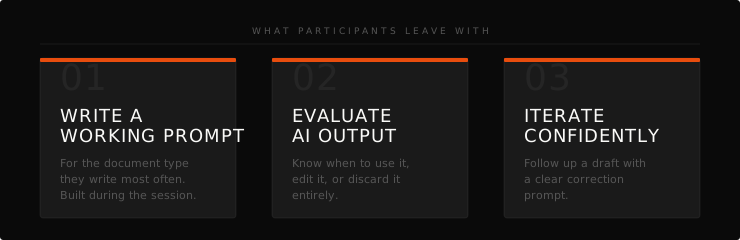
By the end of a three-hour session, a participant who arrived with no prior experience should be able to do three things independently.
First, write a prompt specific enough to produce a usable first draft of the type of document they write most often. Not a perfect draft, but one that reduces the writing time by at least half.
Second, evaluate an AI output clearly. They should be able to identify when the output is accurate and usable, when it needs editing but is worth starting from, and when it has missed the brief entirely. That judgment is what separates someone who uses AI productively from someone who either trusts it too much or not at all.
Third, iterate. The ability to follow a first output with a clear correction prompt, "make the tone more direct," "cut the length by a third," "remove the bullet points," is what makes the tool genuinely efficient rather than a one-shot experiment.
For leadership participants, the session also surfaces a clearer sense of where AI belongs in the team's workflow and what reasonable expectations look like. What it can automate and what still requires human judgment. That clarity is often the most valuable thing an executive takes from a session.
How the session adapts to different teams
The workshop structure is the same for every team. The content is not.
A session for a finance team spends more time on data summarisation, report drafting, and scenario preparation. A session for an HR team covers job descriptions, interview question banks, performance review language, and employee communications. A session for a leadership team focuses more on how to brief AI effectively, how to review AI-generated output, and how to think about AI as a strategic resource across departments.
Teams with a wide range of technical confidence are the most common and require the most calibration during the early part of the session. The goal is to ensure that the least experienced participants leave with a working starting point and that the more experienced ones encounter something new. That balance is managed through task choice during the hands-on period, where participants work at their own level, and through the facilitator's movement through the room.
Remote sessions follow the same structure with screen-sharing replacing the over-the-shoulder facilitation. The dynamic is different but the outcomes are comparable, provided participants come with real tasks and a working internet connection.
What happens after the session
A workshop is a starting point, not a complete solution. Teams that see the best results in the weeks following a session are usually the ones where one or two people take on an informal role as the go-to resource for questions. That person does not need to be an AI expert. They need to be the one who kept experimenting after the session ended and is willing to share what they found.
For organisations that want more structured follow-up, TAMENSAH offers department deep-dives that build on the foundational session with content specific to a single team's workflows, and one-on-one coaching for executives or managers who want a more intensive personal programme.
Before the session, every booking includes a brief pre-session call to understand the team's current workflows, their experience level, and the tasks where they are spending the most time. That information shapes the session directly. It is what makes the difference between a generic AI overview and a training session that reflects the actual work your team does.
See the formats, pricing, and what to expect when you book. Complete the pre-session briefing form to tell us about your team before we speak.
Ready to move from reading about AI to your team actually using it?
See Training Formats & Pricing